Trionyxio
Trail Module
Trail Module
Couldn't load pickup availability
1. Problem Statement
After studying several stages, a learner may have many separate ideas: how to write an instruction, how to build a scenario, how to structure data, how to review a response, and how to work with conditions. The challenge often appears when all these parts need to be gathered into one complete route. Without a clear final structure, separate skills may remain divided between different tasks. A learner may know many methods but may not always see which one to use first, which one to keep for review, and which one to use for refinement. Trail Module was created to help connect all previous topics into one learning path with clear stages, checkpoints, and a final scheme.
2. Solution
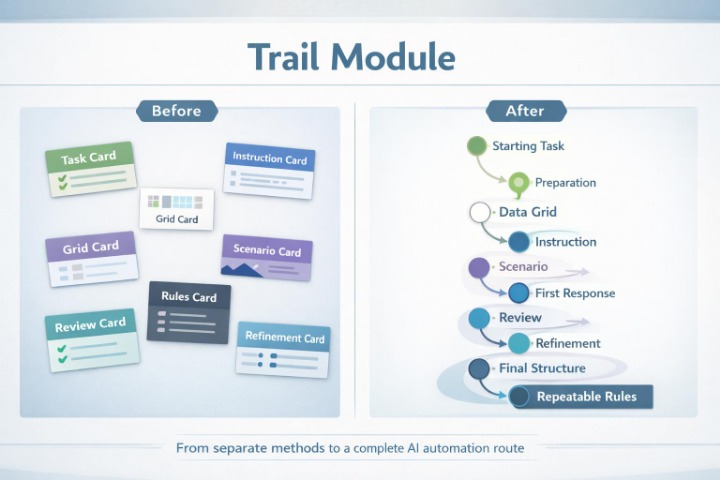
Trail Module explains how to create a full AI automation route from a starting idea to an organized final material. This plan shows how to define the task goal, prepare input, build an instruction, create a scenario, place information in a grid, review a response, refine the structure, and record rules for repeated use. The materials help show how all previous Trionyxio approaches can work together. The learner studies not only separate actions, but also the order in which they can be used within a longer process. Trail Module focuses on a learning route where every stage has its place and supports the next part of the work.
3. What’s Inside
Trail Module contains final learning materials for building a full AI automation route. The first block focuses on the learning path map. It explains how to move from a separate task to a developed process: define the topic, describe the starting goal, gather input materials, divide information into blocks, create an instruction, receive the first version, review it, refine the structure, and form the final format. The learner sees how different parts of the Trionyxio course line connect into one sequence.
The second block focuses on choosing the starting point. The materials explain that not every task begins with writing an instruction. Sometimes it is better to gather data first, sometimes to divide the topic, sometimes to create a grid, sometimes to describe rules, and sometimes to review material that already exists. Trail Module helps learners decide which step to begin with depending on the state of the task. This is especially useful for more complex learning materials where the starting point is not always obvious.
The third block focuses on routes for different task types. The learner reviews separate schemes for text materials, learning plans, course descriptions, organizational processes, idea lists, broad topics, and multi-step scenarios. For each task type, the plan shows its own order: preparation, structure, instruction, first version, review, refinement, and final check. This approach helps learners avoid using the same scheme for every case and instead choose a route according to the task.
The fourth block contains materials about connecting previous plans. It explains how Free Bundle gives initial understanding, Slate Guide helps with wording, Arc Bundle with scenarios, Grid Course with data structure, Echo Set with review, Motion Collection with process movement, Anchor Kit with support rules, Lattice Module with connections, and Cipher Module with instruction precision. Trail Module shows how these elements can be placed inside one learning route without confusion.
The fifth block focuses on checkpoints inside a full process. The learner studies where to pause and review the material: after gathering data, after building structure, after the first response, after refinement, after format changes, and before the final version. Each point includes review questions: is the task clear, is there enough data, are the themes separated, does the structure follow the format, is the logic preserved, are repetitions removed, and is another refinement needed.
The sixth block focuses on final material assembly. The learner studies how to gather intermediate results into one final document, description, plan, or learning scenario. The materials show how not to lose important fragments, how to place sections in the right order, how to align the style, and how to check that the final format follows the starting task. A separate part reviews situations where material needs arrangement rather than expansion.
The seventh block focuses on route reuse. The learner reviews how one created path can be adapted for similar tasks. For example, a route for a course description can be changed for a module description, a route for sorting ideas can be changed for plan preparation, and a route for text review can be used for checking a page with learning materials. The course explains which parts of a route can stay stable and which should change for a new context.
The eighth block contains the Trail Framework — a set of schemes for a full learning route. They are built in the format “starting task — preparation — data grid — instruction — scenario — first response — review — refinement — final structure — rules for repetition.” Each scheme includes an explanation of how to read it, remove extra parts, add intermediate stages, and use it for different learning tasks.
The ninth block focuses on longer processes. The materials explain how to keep order when a task has many parts, several information sources, different formats, and several review stages. The learner studies how to mark intermediate results, keep short notes about changes, record decisions, and avoid mixing older and updated material versions.
The tenth block contains final exercises. The learner receives training tasks where they need to build a full route independently: take a topic, define the starting point, prepare data, create a grid, write an instruction, build a scenario, describe checkpoints, add review rules, and form the final structure. These exercises help revisit previous topics inside one process.
Trail Module also includes a section about common mistakes in full routes. These include a starting point that is too broad, missing preparation, skipped checkpoints, mixing review with refinement, duplicated stages, unclear final format, too many rules in one place, and missing final review. Each mistake is explained through a learning example.
A separate part of the plan is the Trail Review Checklist. It helps check whether the route has a starting task, whether data has been prepared, whether structure has been created, whether the instruction is clearly described, whether there is a scenario, whether checkpoints are marked, whether refinement is included, whether the process is not overloaded, and whether the final material follows the starting goal.
4. Who Is This For?
Trail Module is for learners who want to gather all key Trionyxio approaches into one full AI automation route. This plan may be useful for learners who already work with different task types and want to better understand how wording, structure, scenarios, review, rules, and links can work together.
Trail Module also fits course creators, content-focused workers, editors, learning material organizers, small project coordinators, and anyone who wants to create consistent processes for repeated digital tasks. If Cipher Module helps describe rules with more precision, Trail Module shows how to place those rules inside a full learning path.
5. What You’ll Learn
- Build a full AI automation route.
- Define the right starting point for different tasks.
- Connect instructions, scenarios, grids, rules, and review.
- Create checkpoints for longer processes.
- Work with final material assembly.
- Adapt one route for similar learning tasks.
- Use the Trail Framework to build a process.
- Keep order in longer multi-step scenarios.
- Notice missing or duplicated stages.
- Use the Trail Review Checklist for final review.
6. Refund Terms
Trail Module includes 30-day refund terms according to the Trionyxio store policy. A learner may submit a request within 30 days after placing the order if the materials do not match expectations regarding format or content. Requests are reviewed according to the store policy and the plan description on the order page.
- 💾 Digital file available after purchase
- 📚 Long-term availability
- 🔐 Secure checkout
- 🧾 Content updated in 2026
Self-paced learning overview
1. Do I need previous experience with AI automation?
1. Do I need previous experience with AI automation?
No, Trionyxio materials are arranged so the topic can be studied gradually. The lessons begin with basic ideas, explain the logic of digital processes, and show how a single task can become part of an organized scenario.
2. What format do the materials use?
2. What format do the materials use?
The materials include lessons, modules, examples, text-based schemes, learning explanations, and practical tasks. The main focus is structure, clear language, and examples that can be reviewed without naming third-party programs.
3. Can I study at my own pace?
3. Can I study at my own pace?
Yes, the materials can be studied in a comfortable rhythm. Each block can be reviewed separately, previous explanations can be revisited, and the next topics can be studied gradually without pressure.
4. How are the plans different from each other?
4. How are the plans different from each other?
The plans differ by material volume, topic depth, number of examples, practical tasks, and level of detail. Free Bundle introduces the Trionyxio approach, while the next plans expand AI automation topics through more modules and scenarios.
Share