Trionyxio
Slate Guide
Slate Guide
Couldn't load pickup availability
1. Problem Statement
After the first introduction to AI automation, a new challenge often appears: the learner understands the basic ideas but may not know how to describe a task correctly. Instructions may be too broad, incomplete, or mixed, which makes the response less stable in format. Sometimes a learner has an idea for a process but does not see how to divide it into ordered parts. Another issue is the lack of habit in reviewing the response structure and refining the instruction after the first attempt. Slate Guide was created to help learners move from general understanding to more careful work with wording.
2. Solution
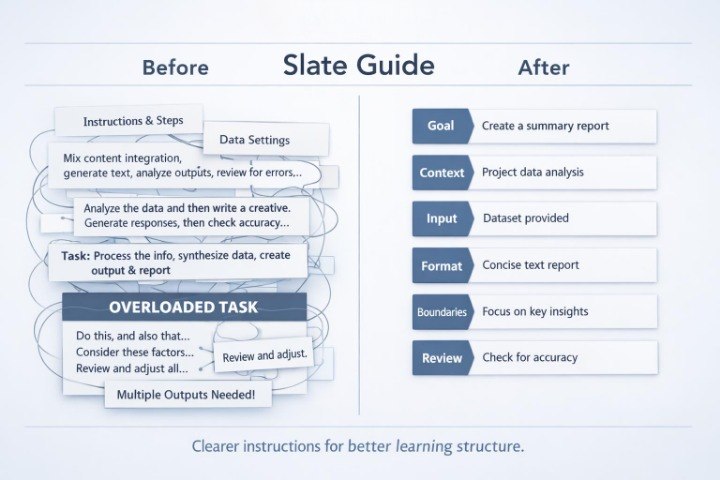
Slate Guide explains how to build learning instructions for AI automation through a clear sequence: goal, context, input, response format, boundaries, and review. The materials show how the same task can look different depending on which details the learner adds. Instead of choosing phrases randomly, the course offers a structured frame for describing a digital action. This approach helps learners see where the wording needs refinement. Slate Guide also teaches learners to view AI automation not as a single instruction, but as a small process with preparation, action, and review.
3. What’s Inside
Slate Guide includes an expanded introduction to working with learning instructions for AI automation. The first block focuses on instruction structure. It explains which parts can be included in a well-described task: a short goal, context, materials for processing, expected format, tone, topic boundaries, and review criteria. The learner sees that an instruction does not need to be long just for length, but it should include the elements needed for clear task handling.
The second block focuses on context. The materials explain why an AI system works better with a learning task when it understands the situation, text purpose, material type, and preferred response structure. For example, one task may involve a short plan, another may involve a course module description, a third may involve sorting notes, and a fourth may involve creating a sequence of actions. Each case needs its own wording, and Slate Guide shows how to notice the difference between such scenarios.
The third block focuses on input. It reviews how to prepare material before building an automation scenario. The learner studies how to separate main facts from secondary details, remove unnecessary repetition, group information by topic, and present data in a form that is easier to work with during the learning process. A separate part explains why many different tasks should not be mixed into one description.
The fourth block includes examples of learning instructions. They show how a weak request can be rewritten into a more structured one. For example, a broad request like “help with a text” can become an instruction with a topic, goal, format, length, style, and review points. Each example is reviewed in parts so the learner can see the role of every element.
The fifth block is dedicated to repeated digital task scenarios. It includes examples for preparing a learning plan, creating an idea list, sorting material, preparing a course description, writing a short instruction, reviewing text structure, and creating a basic workflow route. Each scenario follows the format “task — preparation — instruction — review — refinement.”
The sixth block includes a learning table for instruction analysis. The learner can check whether the task has a goal, context, format, boundaries, input, and review criteria. This table helps learners avoid relying only on intuition and instead review an instruction as a separate learning object.
Slate Guide also contains a short section about common mistakes. These include overly broad wording, missing context, mixing different tasks, unclear response format, too many conditions, and missing review steps. Each mistake is explained through an example so the learner can recognize it in a real learning scenario.
4. Who Is This For?
Slate Guide is for learners who have reviewed starting materials or already have a basic understanding of AI automation, but want to work better with task wording. This plan may be useful for learners who often have an idea for a task but cannot always describe it clearly enough.
Slate Guide also fits creators of learning materials, content-focused workers, digital process organizers, owners of small online projects, and anyone who wants to create more ordered instructions for repeated tasks. The plan does not require complex technical preparation, but it does require attention to details, structure, and text logic.
5. What You’ll Learn
- Create structured learning instructions for AI automation.
- Understand the role of goal, context, format, and input.
- Tell the difference between a broad request and a more precise task description.
- Add topic boundaries without overloading the instruction.
- Divide a digital task into preparation, action, and review.
- Analyze instruction examples in parts.
- Rewrite unclear tasks into understandable scenarios.
- Group information before creating an instruction.
- Check whether the result follows the requested format.
- Use an analysis table to review your own learning instructions.
6. Refund Terms
Slate Guide includes 30-day refund terms according to the Trionyxio store policy. A learner may submit a request within 30 days after placing the order if the materials do not match expectations regarding format or content. Requests are reviewed according to the store policy and the plan description on the order page.
- 💾 Digital file available after purchase
- 📚 Long-term availability
- 🔐 Secure checkout
- 🧾 Content updated in 2026
Self-paced learning overview
1. Do I need previous experience with AI automation?
1. Do I need previous experience with AI automation?
No, Trionyxio materials are arranged so the topic can be studied gradually. The lessons begin with basic ideas, explain the logic of digital processes, and show how a single task can become part of an organized scenario.
2. What format do the materials use?
2. What format do the materials use?
The materials include lessons, modules, examples, text-based schemes, learning explanations, and practical tasks. The main focus is structure, clear language, and examples that can be reviewed without naming third-party programs.
3. Can I study at my own pace?
3. Can I study at my own pace?
Yes, the materials can be studied in a comfortable rhythm. Each block can be reviewed separately, previous explanations can be revisited, and the next topics can be studied gradually without pressure.
4. How are the plans different from each other?
4. How are the plans different from each other?
The plans differ by material volume, topic depth, number of examples, practical tasks, and level of detail. Free Bundle introduces the Trionyxio approach, while the next plans expand AI automation topics through more modules and scenarios.
Share