Trionyxio
Lattice Module
Lattice Module
Couldn't load pickup availability
1. Problem Statement
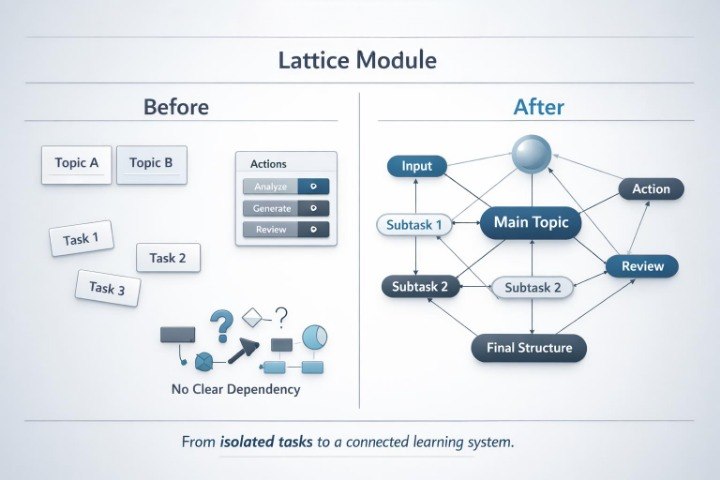
When a learner already works with instructions, scenarios, grids, review, routes, and support templates, the next challenge is connecting several processes into one understandable scheme. One task may depend on another, separate stages may repeat across different scenarios, and some materials may be used in several directions at the same time. Without a clear scheme, these links can become confusing: it may be hard to see what is the starting point, what is intermediate material, and what is the final part. Another issue appears when the learner tries to connect different task types — text-based, organizational, learning, and analytical — without one shared logic. Lattice Module was created to help learners view AI automation as a network of connected elements where every part has its place.
2. Solution
Lattice Module explains how to build connected schemes for AI automation, where several scenarios can work within one learning space. This plan shows how to define task dependencies, separate main and supporting stages, record repeated elements, and create a connection map. The learner studies how one prepared structure can become the base for several next actions: a plan, description, review, refinement, or a new scenario. The materials help avoid mixing all processes into one large block and instead place them inside a clear network. Lattice Module focuses on interaction between parts so more complex AI tasks can be reviewed in an organized way.
3. What’s Inside
Lattice Module contains learning materials that help learners view AI automation as a structure of connected elements. The first block focuses on the idea of a learning lattice. It explains how several tasks can be connected: one prepares data, another creates structure, the third refines material, the fourth reviews sequence, and the fifth forms the final format. The learner sees that a more complex process does not need to be chaotic if it is divided into cells, links, and transitions.
The second block focuses on dependencies between tasks. The materials explain how to define which stage should happen earlier, which can be handled separately, and which needs results from previous steps. For example, before creating a learning plan, it is useful to have a topic, groups of subtopics, and a presentation format. Before reviewing material, a draft or structure is needed. Before refinement, review criteria are needed to understand what should change. This approach helps learners avoid mixing preparation, main action, and review stages.
The third block focuses on connection maps. The learner studies how to describe a process not only as a line, but as a scheme with several directions. In such a map, the learner can mark the starting task, supporting materials, intermediate results, review stages, repeated templates, and final materials. The map helps show which parts of the process depend on each other and which can be changed without affecting the whole structure. This is especially useful for learning tasks where one topic can have several presentation versions.
The fourth block includes examples of learning lattices for different task types. These include building a course structure, creating a module set, preparing page descriptions, organizing learning notes, creating a series of text materials, reviewing a broad topic, and preparing a scenario with several branches. Each example shows how separate instructions, tables, templates, and checkpoints can be connected into one scheme.
The fifth block focuses on repeated elements. The learner studies how to find parts that appear across different processes: goal description, input, presentation style, response format, review criteria, refinement instructions, and final check. The materials show how not to write these elements from the beginning every time, but to create a set of support fragments for different scenarios. At the same time, the course explains how not to make the structure too rigid so it can still change for a specific task.
The sixth block reviews cross-links between materials. For example, one topic list can be used for a course plan, module descriptions, a learning scenario, and a review checklist. One rule set for style can support several pages or several descriptions. One context map can help when creating different instructions. The learner studies how to notice such links and use them without duplication.
The seventh block focuses on branched scenarios. The materials explain that a process does not always move in only one direction. After review, different options may appear: adjust the structure, add examples, shorten the material, divide the topic, change the order, or create an additional subsection. Lattice Module shows how to describe these options in advance so the learner can choose the next step based on the state of the material.
The eighth block contains practical exercises for building a personal learning lattice. The learner receives tasks where they take a broad topic, divide it into blocks, define links between them, mark repeated elements, add checkpoints, and describe possible movement directions after review. The exercises help train not only instruction writing, but also thinking through connections.
The ninth block includes templates for Lattice schemes. They are built in the format “main topic — subtopic — input — action — intermediate material — review — refinement options — final structure.” Separate templates are designed for learning plans, material series, course pages, text scenarios, organizational tasks, and mixed processes. Each template is presented with an explanation of how to read it, change it, and adapt it to different learning situations.
Lattice Module also includes a section about common mistakes when working with more complex schemes. These include too many branches, unclear dependencies, duplicated stages, missing intermediate results, mixing the main task with supporting tasks, weak links between review and refinement, and a scheme that is too complex for repeated use. Each mistake is explained through a learning example.
A separate part of the plan is the Lattice Review Checklist. It helps check whether the scheme has a main topic, whether subtasks are clear, whether dependencies are marked, whether repeated elements are visible, whether intermediate results are defined, whether checkpoints are included, whether the structure is not overloaded, and whether the next possible step after review is understandable.
4. Who Is This For?
Lattice Module is for learners who already work with many AI automation elements and want to connect them into more complex but understandable schemes. This plan may be useful for learners who create material series, prepare several connected descriptions, work with broad topics, or want to see dependencies between different parts of a digital process.
Lattice Module also fits course creators, content-focused workers, editors, learning material organizers, and small project coordinators. If Anchor Kit helps create support templates and rules, Lattice Module shows how these supports can interact in a wider scheme with several directions.
5. What You’ll Learn
- Build learning lattices for AI automation.
- Define dependencies between tasks and stages.
- Separate main, supporting, and review parts of a process.
- Create connection maps for more complex learning scenarios.
- Notice repeated elements across different tasks.
- Use one structure as a base for several materials.
- Work with branched scenarios after review.
- Mark intermediate results between stages.
- Check whether a scheme is not overloaded with extra branches.
- Use the Lattice Review Checklist to analyze your own structure.
6. Refund Terms
Lattice Module includes 30-day refund terms according to the Trionyxio store policy. A learner may submit a request within 30 days after placing the order if the materials do not match expectations regarding format or content. Requests are reviewed according to the store policy and the plan description on the order page.
- 💾 Digital file available after purchase
- 📚 Long-term availability
- 🔐 Secure checkout
- 🧾 Content updated in 2026
Self-paced learning overview
1. Do I need previous experience with AI automation?
1. Do I need previous experience with AI automation?
No, Trionyxio materials are arranged so the topic can be studied gradually. The lessons begin with basic ideas, explain the logic of digital processes, and show how a single task can become part of an organized scenario.
2. What format do the materials use?
2. What format do the materials use?
The materials include lessons, modules, examples, text-based schemes, learning explanations, and practical tasks. The main focus is structure, clear language, and examples that can be reviewed without naming third-party programs.
3. Can I study at my own pace?
3. Can I study at my own pace?
Yes, the materials can be studied in a comfortable rhythm. Each block can be reviewed separately, previous explanations can be revisited, and the next topics can be studied gradually without pressure.
4. How are the plans different from each other?
4. How are the plans different from each other?
The plans differ by material volume, topic depth, number of examples, practical tasks, and level of detail. Free Bundle introduces the Trionyxio approach, while the next plans expand AI automation topics through more modules and scenarios.
Share