Trionyxio
Anchor Kit
Anchor Kit
Couldn't load pickup availability
1. Problem Statement
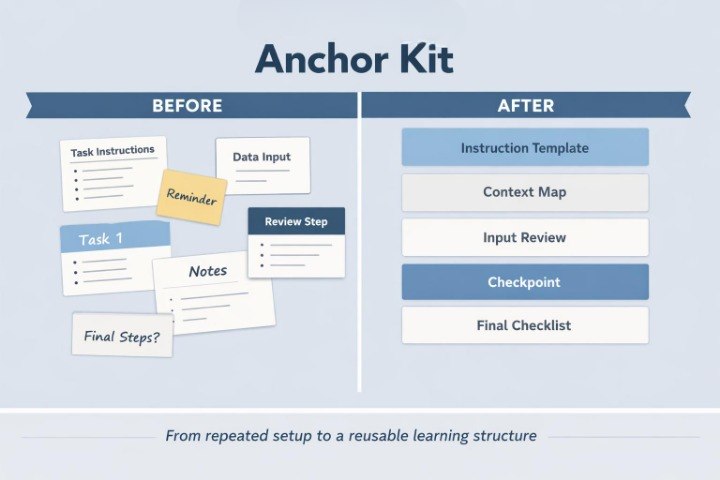
When an AI automation process includes many stages, a learner may lose support between preparation, action, review, and refinement. Even a well-built route can become unclear when there are no fixed rules, templates, or review questions. Because of this, every new task may need to be described almost from the beginning, even though many elements can repeat. Another challenge appears when different scenarios use different styles, different structures, and different levels of detail. Anchor Kit was created to help learners form a stable learning base for repeated processes.
2. Solution
Anchor Kit explains how to create support sets for AI automation: instruction templates, context maps, checklists, review rules, and structures for repeated tasks. This plan shows how to keep one order across different scenarios without turning learning into a rigid scheme. The learner studies how to define stable process elements: goal, input, format, style, review criteria, and next step. The materials help show which parts of a scenario can stay the same and which parts should change for a specific task. Anchor Kit focuses on structure stability so work with AI automation becomes more organized.
3. What’s Inside
Anchor Kit contains learning materials that help learners create their own support system for AI automation. The first block focuses on the idea of a “support structure.” It explains why repeated processes need not only separate instructions, but also general rules that can be revisited when creating new scenarios. The learner sees how one support structure can help different task types: preparing text, sorting ideas, creating a plan, reviewing material, or building a learning route.
The second block focuses on creating a base instruction template. The materials show how to describe a task through stable parts: short goal, context, input materials, preferred format, tone, topic boundaries, review criteria, and refinement method. This template is not presented as an unchangeable form for every case. Instead, the course explains which elements can remain, which can be shortened, and which should be added depending on the learning task.
The third block focuses on context maps. The learner studies how to record important details that should move from one stage to another. These details may include topic, audience group, presentation style, response format, length, key ideas, examples, and boundaries. A context map helps avoid losing important information during longer scenarios. When a process has several steps, this map becomes a reference note showing which data should be considered at each stage.
The fourth block contains materials about checkpoints. It explains how to define places where it is useful to pause and review the material before moving further. For example, after preparing input data, the learner can check whether there are repetitions and whether topics are divided correctly. After creating the first version, the learner can review structure, sequence, and format match. After refinement, the learner can evaluate whether the starting goal is still present. This approach helps move through the process with more attention.
The fifth block focuses on rules for repeated tasks. The learner reviews how to create a personal set of rules for common scenarios. For example, for text material, there can be a rule for checking headings, paragraph length, and transition logic. For a module plan, there can be a rule for dividing topics into parts. For sorting ideas, a rule can include grouping, removing repetitions, and marking priority. The materials show how such rules make the process more predictable in structure.
The sixth block includes the Anchor Kit learning template set. It contains templates for task description, context preparation, input review, scenario building, first-response review, structure refinement, and final review. Each template includes an explanation: why it is needed, which parts can be changed, which details should be checked before use, and how to adapt it to different learning situations.
The seventh block focuses on consistency across different materials. The learner studies how to keep the same logic in descriptions, modules, plans, instructions, and scenarios. This is especially useful when several materials need to be prepared in one style. The block explains how to create a small set of rules for tone, structure, length, example type, and section order. Such a set helps learners avoid starting every task from a blank page.
The eighth block focuses on reviewing a personal system. The materials show how to evaluate whether the support structure has become too complex, whether it contains extra points, whether all templates are actually needed, and whether similar elements can be joined. The learner studies how to keep the system simple, understandable, and suitable for regular use in learning tasks.
Anchor Kit also includes a section about common mistakes when creating support sets. These include templates that are too long, unclear rules, repeated checkpoints, mixing different task types in one template, missing review points, and a structure that is too rigid to reflect differences between scenarios. Each mistake is explained through a learning example so the learner can evaluate personal materials more carefully.
A separate part of the plan is the Anchor Review checklist. It helps check whether the process has a support goal, whether context is recorded, whether the format is defined, whether review criteria are understandable, whether templates contain no repetition, whether there is room for refinement, and whether the structure can be used for a similar task later.
4. Who Is This For?
Anchor Kit is for learners who already work with instructions, scenarios, grids, review, and process routes, but want to create a more stable base for repeated tasks. This plan may be useful for learners who often prepare similar materials, describe repeated processes, work with learning themes, or create several text structures in one style.
Anchor Kit also fits course creators, content-focused workers, editors, small project coordinators, and anyone who wants a personal rule set for working with AI automation. If Motion Collection shows process movement between stages, Anchor Kit helps anchor that movement through stable templates, context maps, and checkpoints.
5. What You’ll Learn
- Create support structures for AI automation.
- Build instruction templates for repeated tasks.
- Record context that moves between stages.
- Define checkpoints in the learning process.
- Create rules for text-based, organizational, and learning scenarios.
- Keep the same logic across different materials.
- Review personal templates and remove extra parts.
- Tell the difference between stable and changing scenario elements.
- Use a checklist to review a support system.
- Build a more organized base for future AI tasks.
6. Refund Terms
Anchor Kit includes 30-day refund terms according to the Trionyxio store policy. A learner may submit a request within 30 days after placing the order if the materials do not match expectations regarding format or content. Requests are reviewed according to the store policy and the plan description on the order page.
- 💾 Digital file available after purchase
- 📚 Long-term availability
- 🔐 Secure checkout
- 🧾 Content updated in 2026
Self-paced learning overview
1. Do I need previous experience with AI automation?
1. Do I need previous experience with AI automation?
No, Trionyxio materials are arranged so the topic can be studied gradually. The lessons begin with basic ideas, explain the logic of digital processes, and show how a single task can become part of an organized scenario.
2. What format do the materials use?
2. What format do the materials use?
The materials include lessons, modules, examples, text-based schemes, learning explanations, and practical tasks. The main focus is structure, clear language, and examples that can be reviewed without naming third-party programs.
3. Can I study at my own pace?
3. Can I study at my own pace?
Yes, the materials can be studied in a comfortable rhythm. Each block can be reviewed separately, previous explanations can be revisited, and the next topics can be studied gradually without pressure.
4. How are the plans different from each other?
4. How are the plans different from each other?
The plans differ by material volume, topic depth, number of examples, practical tasks, and level of detail. Free Bundle introduces the Trionyxio approach, while the next plans expand AI automation topics through more modules and scenarios.
Share